USE CASE

For HR teams

A consistent, coachable process instead of case-by-case judgment calls
Insider risk reaches HR as a conversation you're expected to lead about a record you had no part in building. Security flags unusual activity, Legal asks what you plan to do about it, and you're the one sitting across from a person, weighing what to do, on evidence you can't fully interrogate. Meanwhile, the attempted shortcut the employee tried that started it happened eleven weeks ago, but you have to handle it today. Above changes the order of operations.

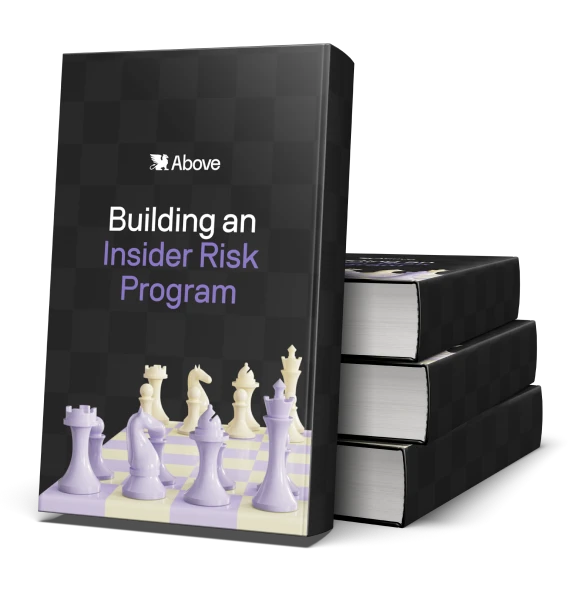
How to build an effective insider risk program

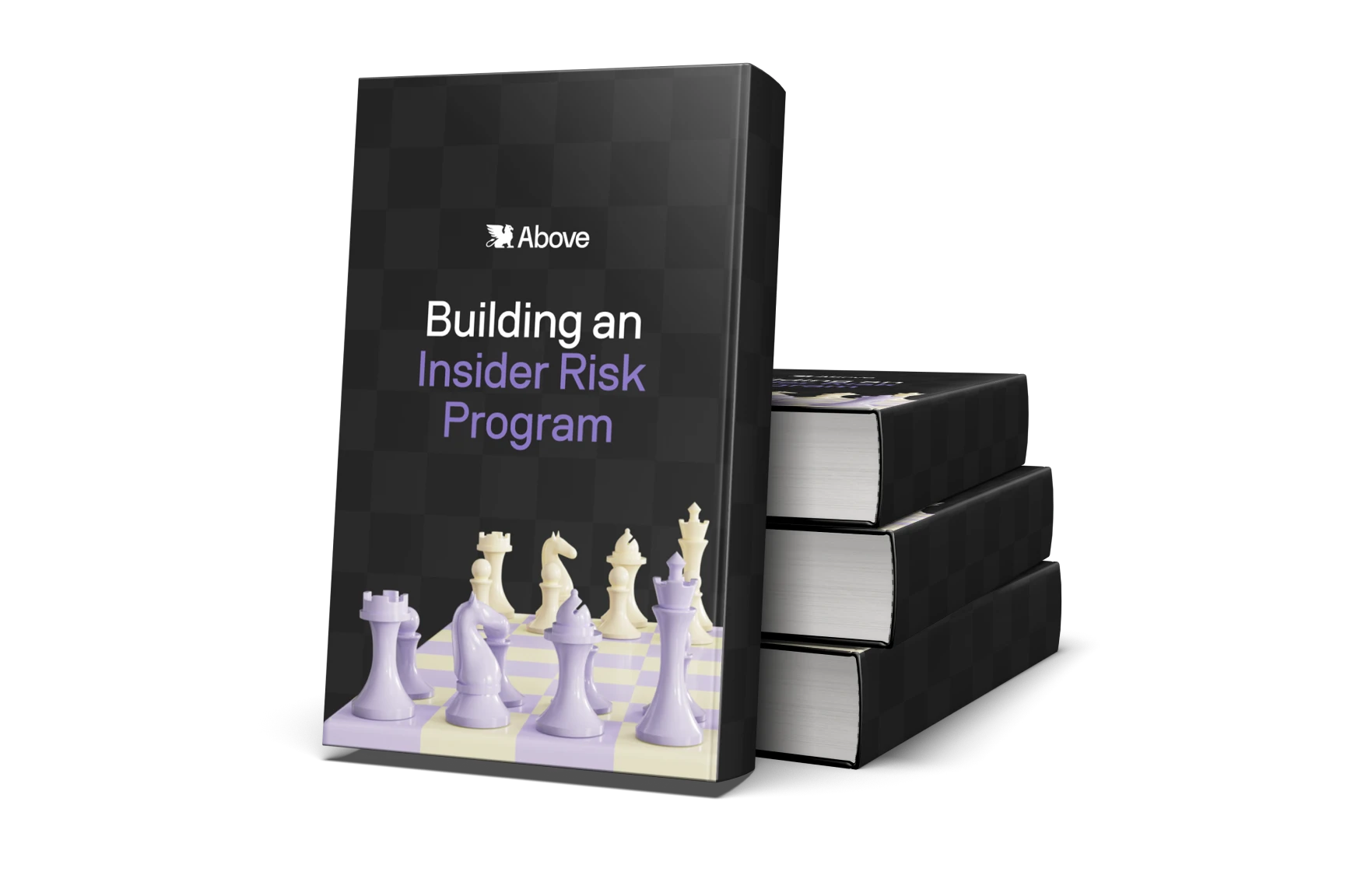
Phil Venables, former CISO of Goldman Sachs and Google Cloud, created a practical blueprint for what to stand up first, how to maintain employee trust, and KPIs to measure to prove program success.
Phil Venables
Get the guide
See it in action

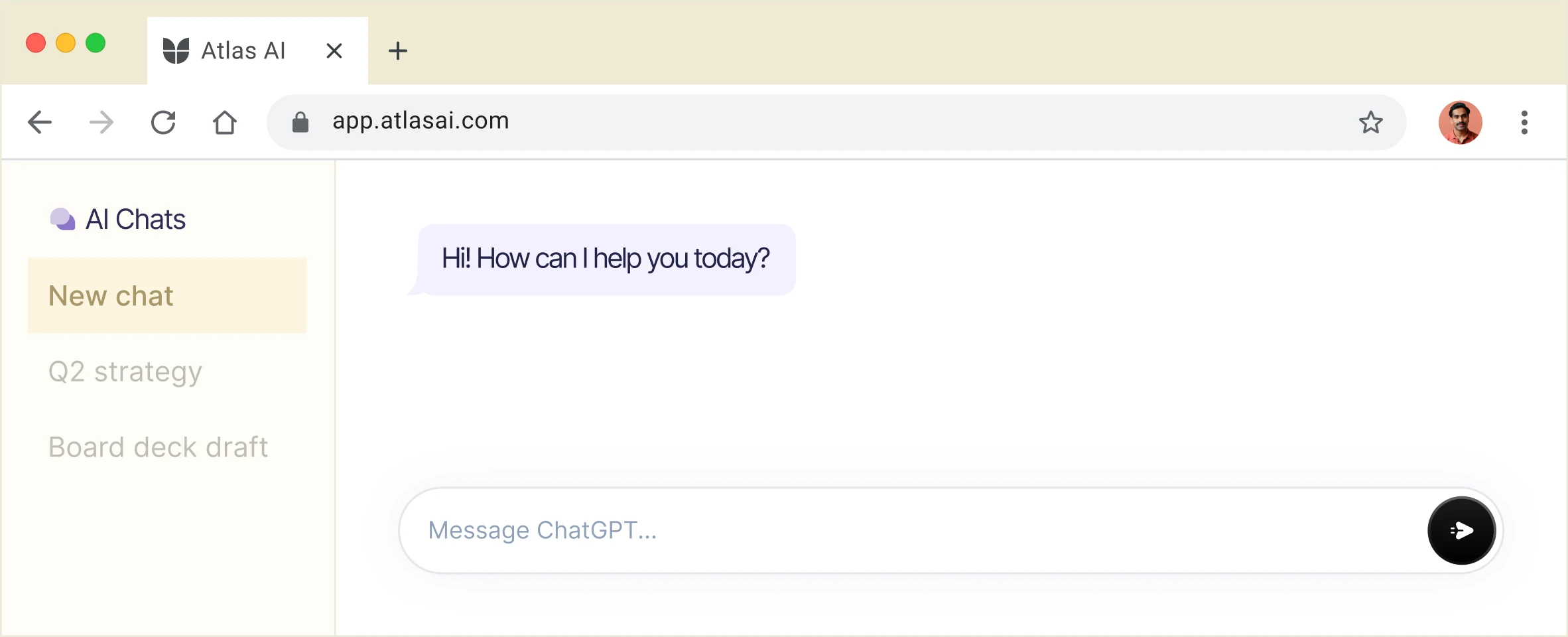
Guidance, the moment it matters

Scroll — watch a risky prompt meet a real Above nudge in the flow of work.

HR’s key insider risk challenges

You're asked to hold the conversation based on a log export
The matter arrives as a technical timeline and a conclusion. You can't tell from a list of file access events whether someone was cutting a corner to hit a deadline, doing exactly what their role requires, or deliberately taking something they shouldn’t with them. A fair conversation needs to start from something the employee can respond to, and a log export isn't that.
Fairness requires consistency, and consistency requires seeing everything
You can only apply a standard evenly if you can actually see comparable behavior. When cases surface based on who happened to trip a rule or catch someone's attention, outcomes diverge for reasons that have nothing to do with what people did. That's the disparate treatment problem, and it's also the credibility problem, because employees notice.
Insider risk
You own the policy but can't see whether it's working
HR writes the acceptable use policy, runs the training, and collects the acknowledgments. Then the feedback loop ends. There's no way to know which teams are drifting, who could use a reminder, or whether the policy is landing at all, until something escalates far enough to become a case. By then you're responding, not preventing.
Your workforce is using tools your policies never anticipated
Contracts pasted into consumer AI tools, work moved to personal accounts, OAuth-scoped agents connected to company data on someone's own initiative. Most of it isn't malice, it's people being resourceful with tools that didn't exist the last time the handbook was refreshed. You're expected to govern behavior nobody was ever security trained on but everyone’s adopted.

The cost of inefficient or no action

You have to deal with incidents that could have easily been prevented
Most insider risk is a well-meaning shortcut. Caught in the moment, it's a thirty-second correction and a better-informed employee. Caught eleven weeks later through an investigation, the same behavior is a documented incident with a formal process attached. Nothing about the conduct changed. The only thing that changed is how late you found out.
You risk employee trust with inefficient, inaccurate investigations
Being investigated is corrosive whether or not the outcome is discipline, and a case built on ambiguous access logs often can't fully clear anyone either. The average containment time for an insider incident is 81 days. That's months of a person, a manager, and a team sitting inside an unresolved question, and word travels regardless of how it ends.
Your data is out the door before you can stop it when an employee offboards
Pre-departure staging is the most common critical insider pattern, and leavers are around 69% more likely to take data with them. HR runs the exit process, which means HR is closest to the signals that matter and usually the last to be told they mattered. Finding it on the offboarding checklist means the data is already gone.
Employee relations work you can't forecast
Every escalation lands as unplanned ER hours: interviews, documentation, coordination with Security and Legal, sometimes outside counsel. Ponemon puts the average annual cost of insider risk at $19.5M per organization and $676,517 per incident, across roughly 13.5 incidents a year. A share of that is your team's time, spent on matters that were preventable earlier and cheaper

What’s my organization’s level of insider risk?

Determine your level of risk across 5 critical security pillars in 10 minutes or less. You get your score, plus optimization recommendations.

Take the free evaluation

How Above helps HR teams

Detect, investigate, and prevent insider threats
Arbiter Engine is the AI-native workflow layer underneath detection, investigation, and prevention.
The same standard applied the same way, every time. Comparable behavior surfaces comparably instead of depending on which rule fired or who noticed, which is the only real foundation for treating people consistently.
Learn More
Every incident, already investigated
A fleet of specialised AI agents- Shadow AI & IT, Data Exfiltration, Flight Risk, Inappropriate Use, Communications- reasoning continuously across identity, SaaS, endpoint, and data access.
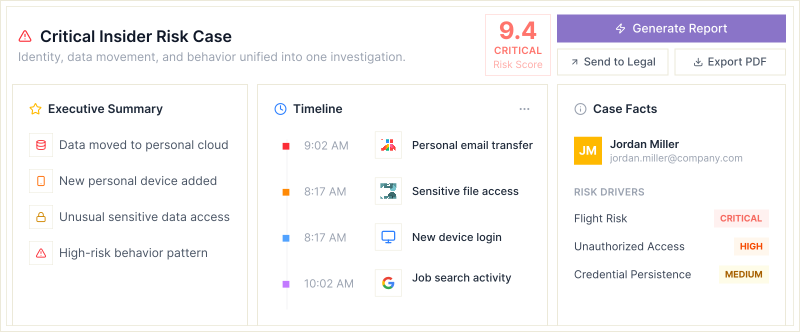
You walk into the conversation understanding what happened, in what order, and what’s normal or abnormal behavior from this individual. The reasoning is legible, not just the raw activity, so the employee can be shown the same picture and respond to it.
Learn More
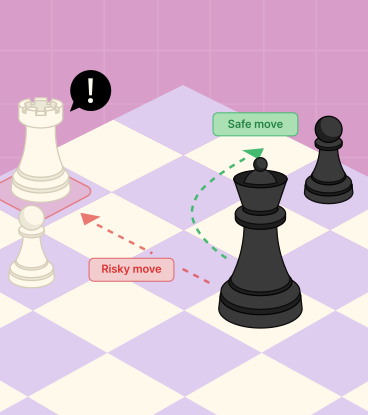
Stops risky moves before they’re made
Company-approved guidance surfaced inside email, SaaS, and AI tools at the moment a risky move takes shape.
Above provides coaching at scale, preventing incidents before they can happen. Security policy stops being something employees acknowledge once a year in mandatory training and becomes something they practice daily. Most people correct course when told, and that correction never becomes an ER file.
Learn More
A team-wide case management cockpit
Find finished cases, evidence, collaboration, and handoff in one place, The Investigation Workspace.
One record for Security, Legal, and HR instead of three partial ones, with role-based access so you see what you need for the employment decision without inheriting the entire technical picture. The ER file is complete without being assembled twice.
Learn More
Continuous investigations that update with new evidence
Evidence Graph follows the evidence, not the other way around. Activity is mapped across people, AI agents, applications, and data when it becomes relevant, and connects them as evidence arrives.
An early read doesn't harden into a conclusion. Context that explains someone's behavior counts as evidence too, and it changes the picture as it arrives, which is what keeps you from drawing a conclusion before all the evidence is applied.
Learn More
Integrations with your existing tools
Connections across cloud, identity, endpoint, SaaS, HR, AI, workplace tools, and more.
Above runs on the telemetry your company already generates, querying those sources rather than duplicating them. No new monitoring layer to introduce to the workforce, and nothing new to explain to a works council.
Learn More
With Above, enforcement becomes coaching, case-by-case judgment becomes a consistent process, and HR stops being handed premature conclusions about people and starts shaping safe behavior.

Turn insider risk into a security advantage

See how Above helps security teams detect, investigate and prevent insider threats -- without the manual work.
Request demo

Common questions

How does Above change my day-to-day?
Fewer matters reach you at all, because the small stuff gets corrected before it compounds. The ones that do arrive come with a timeline and context you can read, so the conversation starts from shared facts rather than an accusation. Decisions are easier to defend, because the same process produced them. And you get a feedback loop on policy for the first time: which behaviors are actually happening, where, and whether the guidance you wrote is changing anything.DLP enforces policy on data movement; UEBA flags deviation from a statistical baseline. Both assume insider risk can be defined in advance, as a rule or as an anomaly. Above starts from a different premise: insider risk is an investigation problem, not a policy problem. Instead of asking whether an action broke a rule or looked unusual, Above's agents investigate what a person was doing across systems and over time, and reason about whether it indicates risk. You keep DLP for the compliance job it does well. Above answers the question it was never built for.
Does this mean monitoring every employee?
Above investigates behavior, not people, and it's built to be privacy-aware: no keystroke logging, no screen recording. It reasons over the activity your systems already record, rather than introducing a new layer of surveillance, and access is role-based so what HR sees is scoped to what the employment decision requires. The platform builds an understanding of role context, team patterns, and activity sequences precisely so it can tell benign change apart from negligence, circumvention, and genuine risk. Most of what surfaces is coachable, and a good share of it gets corrected in the moment without becoming a case at all.
Will it flag people unfairly?
The concern is the right one, because the tools that came before Above did exactly that. UEBA baselines treat the promotion, the new project, and the deadline sprint as deviations, which means high performers with changing work get flagged the most. Above reasons about what someone's role, team, and recent work make normal, and about the sequence of what they did, rather than scoring distance from a statistical average. That's what keeps a case from being opened on someone who simply changed projects.
How is this different from the DLP and UEBA we already run?
DLP enforces policy on data movement; UEBA flags deviation from a statistical baseline. Both assume insider risk can be defined in advance, as a rule or as an anomaly. Neither produces something you can act on legally: a fired rule tells you a threshold was crossed, not what a person was doing or why. Above starts from a different premise, that insider risk is an investigation problem, not a policy problem. Keep DLP for the compliance job it does well. Above answers the question it was never built for.
Learn more about DLP and UEBA's blind spots
How do we introduce this without our employees reading it as surveillance?
Lead with the part employees actually see. Real-time guidance is visible, useful, and on their side: it tells someone that the file they're about to move is sensitive, before it becomes a problem for them. Programs land better when the first experience of them is help rather than consequence, and when the commitments are concrete and stated up front — what is looked at, what isn't, who can see it, and what happens next. The absence of keystroke logging and screen recording is worth saying plainly, in those words.

Every endgame starts with the right opening.

Most insider threats are preventable.
The difference is how you develop your material.
Ready to make your move?
Schedule demo

Contact us

You've made a great move.
We'll be in touch shortly

Close

Every endgame starts with the right opening.

Most insider threats are preventable.
The difference is how you develop your material.
Ready to make your move?
Schedule demo