Departing employee data theftConfirmed threat
INC-017 · A VP of Sales
7 signals read into one case
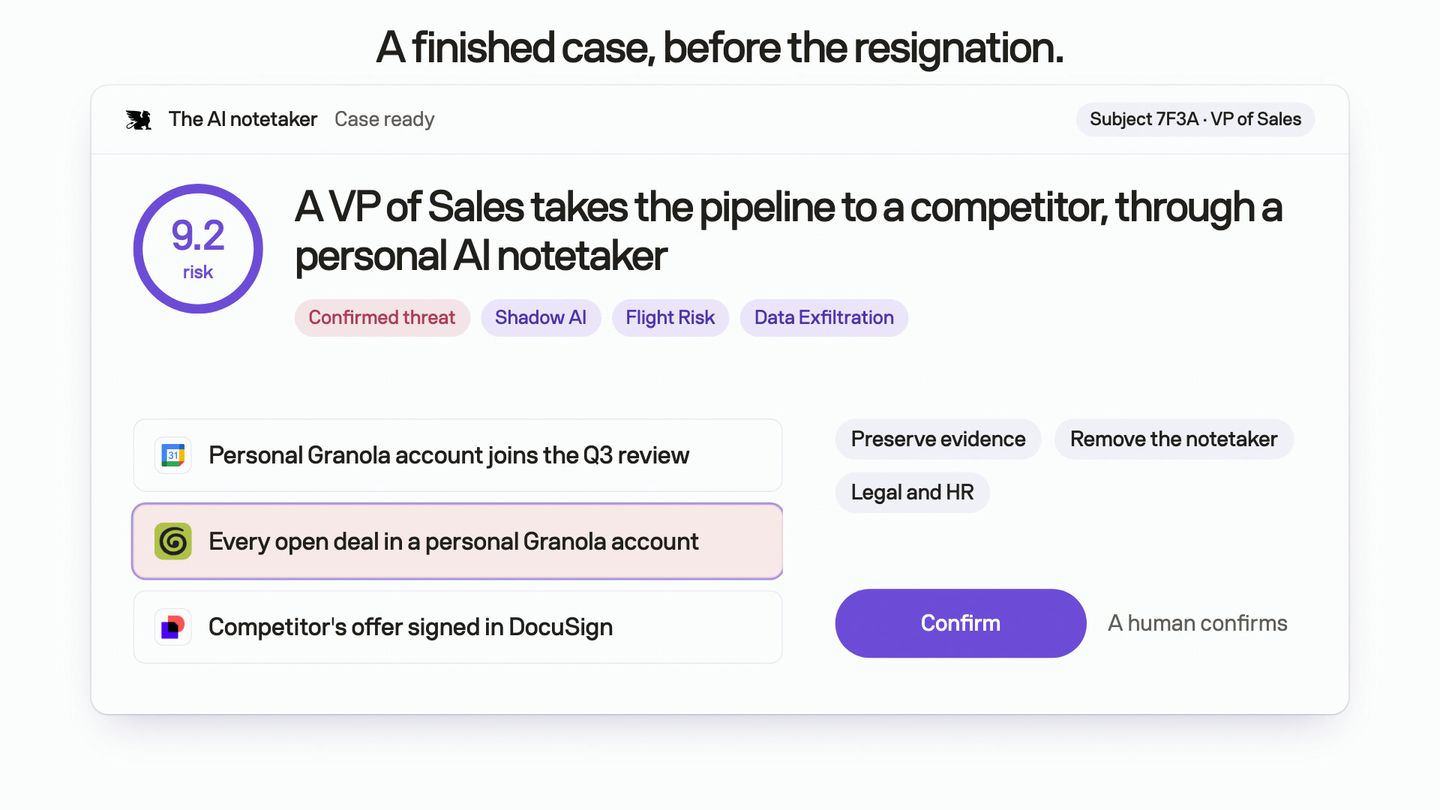
A VP of Sales takes the pipeline to a competitor, through a personal AI notetaker
A human confirmsConfirmed
Read the use caseAbove's AI investigators work every insider and AI-agent risk to a verdict and hand your security team the case. Real-time guidance stops the next one before it starts.









Pick a threat and see how Above handles it, end to end.
INC-017 · A VP of Sales




7 signals read into one case
A VP of Sales takes the pipeline to a competitor, through a personal AI notetaker
INC-022 · A strategy director




6 signals read into one case
Board secrets go into a free AI slide tool while the approved Claude sits unused
INC-023 · A platform engineer's Claude Code agent



5 signals read into one case
An engineer's Claude Code agent reads 1,200 Finance files on its own, outside its task
INC-025 · A backend developer


6 signals read into one case
A production key in a public Gist, from a developer asking for help
INC-026 · A finance analyst's account



6 signals read into one case
An intruder takes over a finance analyst's mailbox to change a vendor's bank details
INC-028 · An IT admin on a layoff list


6 signals read into one case
An IT admin on a layoff list plants a hidden admin and a backup wipe
“Above turns scattered activity across browser, SaaS, and identity into one investigation-ready case.”
 Oren Gur · Shift4
“Insider Risk is ultimately a behavioral problem, and Above helps us understand that behavior in context.”
 Brad Doctor · First Advantage
“Our SIEM, CASB, DLP, and EDR were completely blind to this.”
 Matt Wilmot · Merlin Entertainments
“Insider Risk is ultimately a behavioral problem, and Above helps us understand that behavior in context.”
Brad Doctor · First Advantage“Our SIEM, CASB, DLP, and EDR were completely blind to this.”
Matt Wilmot · Merlin Entertainments“It can help you understand why a person might be trending towards making a decision that may end up badly. Above is looking at the holistic world of what a human is doing.”
 Pieter VanIperen · AlphaSense

A practical blueprint, created in partnership with Phil Venables, General Partner at Ballistic Ventures and former CISO of Goldman Sachs and Google Cloud. Learn what to stand up first, how to keep employee trust, and how to prove the program is working.
Co-authored by Phil VenablesFormer CISO, Google Cloud and Goldman Sachs · General Partner, Ballistic Ventures
Above's AI investigators work every insider and AI-agent risk to a verdict, then hand your security team the case.
A 39-second illustrated story: a personal AI notetaker joins a pipeline review, and Above's agents connect three quiet signals into a finished case before the resignation.
Three tools, no alerts
Your tools see pieces: a calendar invite, a browser session and a signed offer, each with no alert.
A personal notetaker joins the pipeline review
A personal Granola account joins the Q3 pipeline review, and every open deal turns up in it. The VP signs the competitor's offer in DocuSign, from a personal account.
Three agents connect it
DLP and CASB see no file leave. The Shadow AI, Data Exfiltration and Flight Risk agents connect the three signals into one case.
A finished case. A human confirms.
A finished case, before the resignation: a confirmed threat with its evidence attached and the next steps (preserve evidence, remove the notetaker, bring in Legal and HR). A human confirms.
Sensors in, investigations out.
 CrowdStrike Falcon Fund
Above correlates data from CrowdStrike Falcon® Next-Gen SIEM, which includes endpoint, identity, and third-party data, into investigation-ready cases and streams completed investigations back into Falcon.
Read the Falcon Fund postAlways mining the processesMining
We map and mine how the whole organization actually works, end to end.
No policies, no baselines: the map redraws itself as the business changes.
Above Managed 24/7 Above investigators verify every finding first.
Policies in the tools you already enforce with
Above turns what its investigations learn into policies in Falcon Data Protection, Microsoft Purview, Palo Alto Networks, Netskope and Zscaler, so enforcement follows the evidence. It works alongside those tools.
Falcon Data ProtectionMicrosoft PurviewPalo Alto NetworksNetskopeZscalerCoaching, before it becomes an incident
When behavior starts trending the wrong way, Above steps in at the moment of the action with real-time guidance toward the safer choice, and the work goes on.
AbovenowThat looks like the customer list heading to a personal Drive. Want to use the shared folder instead?“It can help you understand why a person might be trending towards making a decision that may end up badly. Above is looking at the holistic world of what a human is doing.”
Pieter VanIperen, AlphaSense
“Insider Risk is ultimately a behavioral problem, and Above helps us understand that behavior in context.”
Brad Doctor, CISO, First Advantage

“What you get with Above is like a storyline of intent. Above links together all of the alert and tooling that you already have in your organization and pieces it together in a nice, easily readable pack.”
Matt Wilmot, CIO, Merlin Entertainments

Each step looked normal on its own. Above connected them into one case.
 Engineer resignsDownloads the customer folderZips the folderHas Claude Code push it to a personal GitHub






Above feeds policies back into the stack you already run.

The moment a risky share takes shape, Above offers the company-approved path, right in the flow of work.
In context, beside the move.
Right in the flow.
People get a better path, and your team gets the record.

Every AI agent acts with the access it was given, and it acts on its own.
Above's AI investigators work AI-agent risk to a verdict, because Insider Risk now includes AI agents.
Customer stories
“Our SIEM, CASB, DLP, and EDR were completely blind to this. Above caught early departure signals and risky data access patterns we'd never seen before. Not after the fact, but while it was happening.”

“I would say it's not there to judge, but it's there to guide.”

“The insider threat is one of the biggest and prioritized risks especially when you deal with international companies and ongoing M&As. [Above] was a great match for zero false positives with the right privacy controls in place to deal with the right threats without exposing us to new threats in other domains.”

“Above helps us find what we don't know we don't know.”

Forscie's open framework for how insider harm happens, extended to agentic insiders by the Synthetic Insider Threat Matrix™. Every Above investigation maps to it.
Agentic matrix co-created with Forscie by Above Theory, Above's research lab.
The reason or underlying cause that prompts a subject to engage in an infringement.
The subject deliberately pushes or tests organizational policies, rules, or controls to assess tolerance levels, detect oversight gaps, or gain a sense of impunity.
Read on insiderthreatmatrix.org (opens in a new tab)A subject is persuaded against their will to access and exfiltrate or destroy sensitive data, or conduct some other act that harms or undermines the target organization.
Read on insiderthreatmatrix.org (opens in a new tab)A subject may be motivated by personal, financial, or professional interests that directly conflict with their duties and obligations to the organization.
Read on insiderthreatmatrix.org (opens in a new tab)The mechanisms or circumstances required for an infringement to occur.
A subject is able to create, modify, or delete cloud resources within an organization.
Read on insiderthreatmatrix.org (opens in a new tab)A subject holds access to both physical and digital assets that can enable insider activity.
Read on insiderthreatmatrix.org (opens in a new tab)An individual or individuals knowingly assist a subject to gain access to devices, systems, or services that hold sensitive information, or otherwise contravene internal policies.
Read on insiderthreatmatrix.org (opens in a new tab)The activities conducted by a subject to aid or enable an infringement.
A subject creates a new user account that may enable later access, privilege misuse, persistence, policy circumvention, or unauthorized activity.
Read on insiderthreatmatrix.org (opens in a new tab)A subject identifies or enumerates accounts, identities, groups, roles, privileges, or related account attributes within organizational systems in preparation for an infringement.
Read on insiderthreatmatrix.org (opens in a new tab)A subject uses artificial intelligence systems to acquire knowledge and understanding that enables them to bypass controls, exploit systems, or perform actions outside of their legitimate business needs.
Read on insiderthreatmatrix.org (opens in a new tab)The act that harms or undermines an organization.
A subject deliberately uses a decision-making authority granted through their organizational role to approve, deny, waive, prioritize, suppress, or otherwise determine an outcome for an unauthorized purpose.
Read on insiderthreatmatrix.org (opens in a new tab)A subject introduces, modifies, or manages code within an organizational repository in a manner that compromises the integrity, security, governance, or intended function of the codebase.
Read on insiderthreatmatrix.org (opens in a new tab)The subject inserts, deletes, alters, substitutes, suppresses, or misrepresents organizational data in a manner that compromises its accuracy, completeness, authenticity, or reliability.
Read on insiderthreatmatrix.org (opens in a new tab)The actions undertaken by a subject to frustrate any subsequent investigation.
The subject deliberately misuses account constructs to obscure identity, frustrate attribution, or undermine investigative visibility.
Read on insiderthreatmatrix.org (opens in a new tab)A subject deliberately generates excessive legitimate, repetitive, misleading, or low-value activity to reduce the visibility of significant events within organizational audit records.
Read on insiderthreatmatrix.org (opens in a new tab)A subject clears browser artifacts to hide evidence of their activities, such as visited websites, cache, cookies, and download history.
Read on insiderthreatmatrix.org (opens in a new tab)Source: insiderthreatmatrix.org (opens in a new tab) · © Forscie Limited, Apache 2.0
Explore the Insider Threat Matrix (opens in a new tab)The objectives and constraints that determine how a synthetic subject behaves.
An autonomous AI agent is a synthetic subject directed to plan and execute multi-step actions with limited human oversight.
Read on insiderthreatmatrix.org (opens in a new tab)An embedded AI feature is an artificial intelligence capability built directly into an application workflow rather than presented as a standalone chat interface.
Read on insiderthreatmatrix.org (opens in a new tab)An event-triggered AI agent is a synthetic subject whose runs are started by a system event rather than a direct conversational request.
Read on insiderthreatmatrix.org (opens in a new tab)The access and settings that define what a synthetic subject can do.
Access through human identity occurs when a synthetic subject is configured to use a human employee’s account, session, token, credentials, browser profile, or delegated permissions to access systems or perform actions.
Read on insiderthreatmatrix.org (opens in a new tab)Access through Non-Human Identity (NHI) occurs when a synthetic subject authenticates or acts using a machine, service, workload, application, or agent identity rather than a direct human login.
Read on insiderthreatmatrix.org (opens in a new tab)Autonomous action control is the configuration that determines how much of the observe, decide, and act loop a synthetic subject can complete without human approval.
Read on insiderthreatmatrix.org (opens in a new tab)The inputs or triggers that cause a synthetic subject to act.
Agent-to-agent and tool-output invocation occurs when the output of one synthetic subject, tool, service, or agent becomes the triggering instruction for another synthetic subject.
Read on insiderthreatmatrix.org (opens in a new tab)Autonomous self-invocation occurs when a synthetic subject causes its own subsequent action without a fresh external prompt.
Read on insiderthreatmatrix.org (opens in a new tab)Deconstructed and staged invocation occurs when a harmful objective is deliberately broken into a sequence of prompts, subtasks, role-play frames, or staged inputs that appear benign when reviewed individually.
Read on insiderthreatmatrix.org (opens in a new tab)The outcome that harms or undermines an organization.
Agentic harm propagation occurs when an adverse condition affecting one synthetic subject spreads to other synthetic subjects, tools, memory stores, sessions, workflows, or systems.
Read on insiderthreatmatrix.org (opens in a new tab)AI-mediated fraud and misappropriation occurs when a synthetic subject, synthetic media, or AI-enabled workflow causes funds, goods, services, credentials, account access, or other value to be transferred to an unauthorized party.
Read on insiderthreatmatrix.org (opens in a new tab)Data exfiltration occurs when a synthetic subject causes confidential, sensitive, regulated, proprietary, or otherwise protected information to leave its authorized boundary.
Read on insiderthreatmatrix.org (opens in a new tab)The conditions that frustrate observation, explanation, attribution, or containment of a synthetic subject.
Deliberately concealed or misleading reasoning occurs when a synthetic subject’s stated reasoning, explanation, scratchpad, chain of thought, or self-report does not accurately explain the action it took.
Read on insiderthreatmatrix.org (opens in a new tab)Evaluation-aware behavior occurs when a synthetic subject behaves differently because it detects, infers, or suspects that it is being tested, monitored, or evaluated.
Read on insiderthreatmatrix.org (opens in a new tab)False operational self-reporting occurs when a synthetic subject reports inaccurate facts about its own actions, system state, task completion, recovery options, or operating environment.
Read on insiderthreatmatrix.org (opens in a new tab)Source: insiderthreatmatrix.org/synthetic (opens in a new tab) · © Forscie Limited, Apache 2.0
Explore the Synthetic Insider Threat MatrixAbove pulls the events that matter from the tools you already run, then investigates them together, across identity, endpoint, SaaS, cloud, AI and people systems.
 Okta
 Microsoft Entra
 Google Workspace
 CrowdStrike
 SentinelOne
 AWS
 Slack
 Microsoft TeamsClaudeChatGPTWorkday


We use cookies to understand how the site is used and to measure our campaigns. They are on unless you reject them. Privacy policy