Above mentioned in Gartner's Secure Behavior Management research
Read more



Aviv Nahum
October 14, 2026

Aviv Nahum
Oct 15, 2026
On October 13, 2026, CrowdStrike reported that its Counter Adversary Operations team collaborated with the FBI to disrupt several U.S. laptop farms used by FAMOUS CHOLLIMA, a North Korea-linked adversary. These sites allowed operatives abroad to appear to be legitimate American remote employees and remotely access employer-issued computers.
That same day, the FBI released updated guidance on North Korean IT-worker operations, warning that the schemes increasingly rely on facilitators, stolen identities, and third-party labor. The bureau links the threat to illicit revenue, sensitive data theft, extortion, and national security risks.
This is more than a story about fraudulent hiring. It raises a fundamental question for enterprise security: Who is actually controlling the identity and the endpoint your organization trusts?
Remote employment assumes that the person who passed screening and received an employer-issued computer is the person actually performing the work. The FAMOUS CHOLLIMA infrastructure exploited that assumption.
According to CrowdStrike's October 13 report, facilitators at U.S. addresses received employer laptops and installed hardware or software that enabled remote access. CrowdStrike also described deceptive device shipments, hidden remote-management tools, and reuse of disguised hardware identifiers across victim organizations.
The FBI reports that operators are spreading infrastructure across a larger number of smaller laptop farms, using facilitators for interviews, identity verification, professional accounts, and keeping computers connected to the internet.
From an application’s perspective, a successful login from an approved corporate laptop can look routine. But a trustworthy device and a valid account do not, by themselves, establish who is on the other side of the session.
Most organizations imagine an insider threat as an employee who turns malicious, makes an error, or has their account compromised after joining. This campaign demonstrates another path: the employment relationship itself may be fraudulent.
An attacker can acquire seemingly legitimate access to sensitive business applications, customer information, intellectual property, and internal communications without exploiting a conventional software vulnerability.
That is precisely why this belongs in the insider-risk conversation. The consequential activity can occur inside authorized systems, using privileges that were formally granted during onboarding.
Above previously referenced FAMOUS CHOLLIMA in our announcement of CrowdStrike Falcon Fund's investment in Above Security. The new takedown makes the underlying challenge concrete: technical access and organizational trust are not the same thing.
CrowdStrike and the FBI identify several observations worth examining: unexpected remote-computing applications such as AnyDesk, hardware KVM devices such as PiKVM, location and time-zone inconsistencies, unusual shipment addresses, and reuse of contact details across professional identities.
However, an indicator is not a verdict. Remote support tools are used legitimately. Employees travel and work unusual hours. And legitimate candidates can be victims of identity theft.
The FBI specifically recommends an identity-in-depth approach: layered controls and the correlation of multiple weak signals throughout employment. It cautions that aggressive screening can produce harmful false positives.
That balance matters. Security teams need to investigate suspicious patterns, preserve counterevidence, and escalate responsibly instead of turning a single VPN connection or unfamiliar application into an accusation.
What should a modern investigation actually look like?
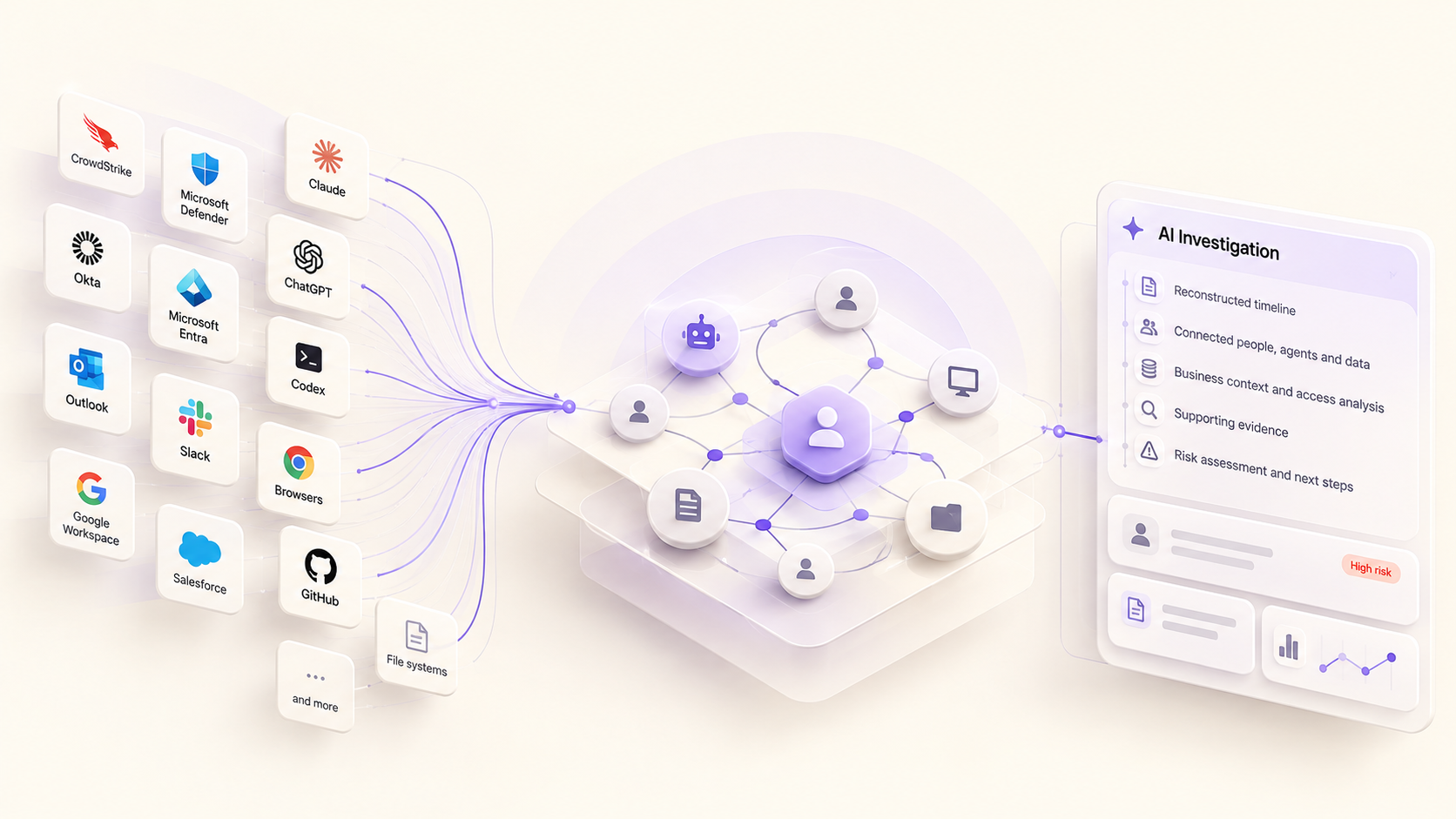
Start with the endpoint: are there unusual remote-control processes, device attachments, or other signs of indirect access? Then connect identity records: where and how has the account been used, and do its authentication patterns make sense? Examine SaaS and collaboration activity: what data was accessed, shared, downloaded, or exported? Finally, add business context: does that behavior correspond to the employee's role and actual work?
None of these sources tells the full story alone. An investigator needs a timeline that connects them.
That's the problem Above Security works on: correlating endpoint, identity, application, and business-context evidence into continuous behavioral investigations. We leverage existing endpoint infrastructure, including CrowdStrike Falcon, and can use targeted collection when a case requires deeper endpoint information.
To be clear, Above did not participate in the reported FBI operation. Our perspective here is on the investigative capabilities these cases illustrate.
CrowdStrike cautions that disrupting individual laptop farms may have limited lasting effects because FAMOUS CHOLLIMA continues to adapt. Organizations cannot build a durable defense solely around yesterday's device identifiers or remote-access tools.
The deeper problem is the gap between an authorized digital identity and the actor operating through it.
Closing that gap takes continuous observation, contextual investigation, and evidence-based decisions across the entire employee lifecycle.
Sources: FBI IC3 advisory, October 13, 2026 and CrowdStrike report, October 13, 2026.



May we use analytics cookies to understand visits, clicks and demo requests? Your choice won’t affect the site. No session recordings. Privacy policy