Above mentioned in Gartner's Secure Behavior Management research
Read more



Amir Boldo
October 14, 2026
Amir Boldo
Oct 15, 2026
Insider threat has been in the news quite a bit lately, and one of the loudest examples is the recent OpenAI engineer case. On October 13, the Department of Justice announced charges against an OpenAI engineer accused of hiding an audio recording device in an executive conference room at the company’s San Francisco office. According to the complaint, the room hosted discussions of confidential technical, commercial and strategic information. Federal officials described the case as a matter of national security, not only a corporate one.
OpenAI staff moved swiftly after finding the device, leading to an equally swift FBI arrest a mere 9 days after discovery. The company used its own models to understand what it was and trace where it came from, which led to a specific employee. Before AI, that attribution would likely have taken significantly longer, if it happened at all.
When we set forth to create Above, it was cases just like this we sought to prevent. The device wasn’t the beginning of the threat, in fact it’s much more endgame than opening. Everything that happened before anyone found it is what warrants more study: weeks of quieter activity that pointed in the same direction once you read it together.
In insider incidents, discovery is usually the boom. In this case, it was a physical device, but this can also be digital, like a file appearing somewhere it shouldn't. The problem there is that by the time of discovery, the work is forensic, and forensics are reactive. You are reconstructing what happened, not changing what happens next.
This is exactly why we harp on proactive risk management. The criminal complaint describes a sequence that started well before the device was found, and much of it happened in software the company already ran.
Figure 1 shows the multiple preemptive touch points plainly. The first event showed up in July and ran all the way until the arrest in October. (It’s important to note that all of the following are allegations from the complaint and the DOJ release, not proven findings.)
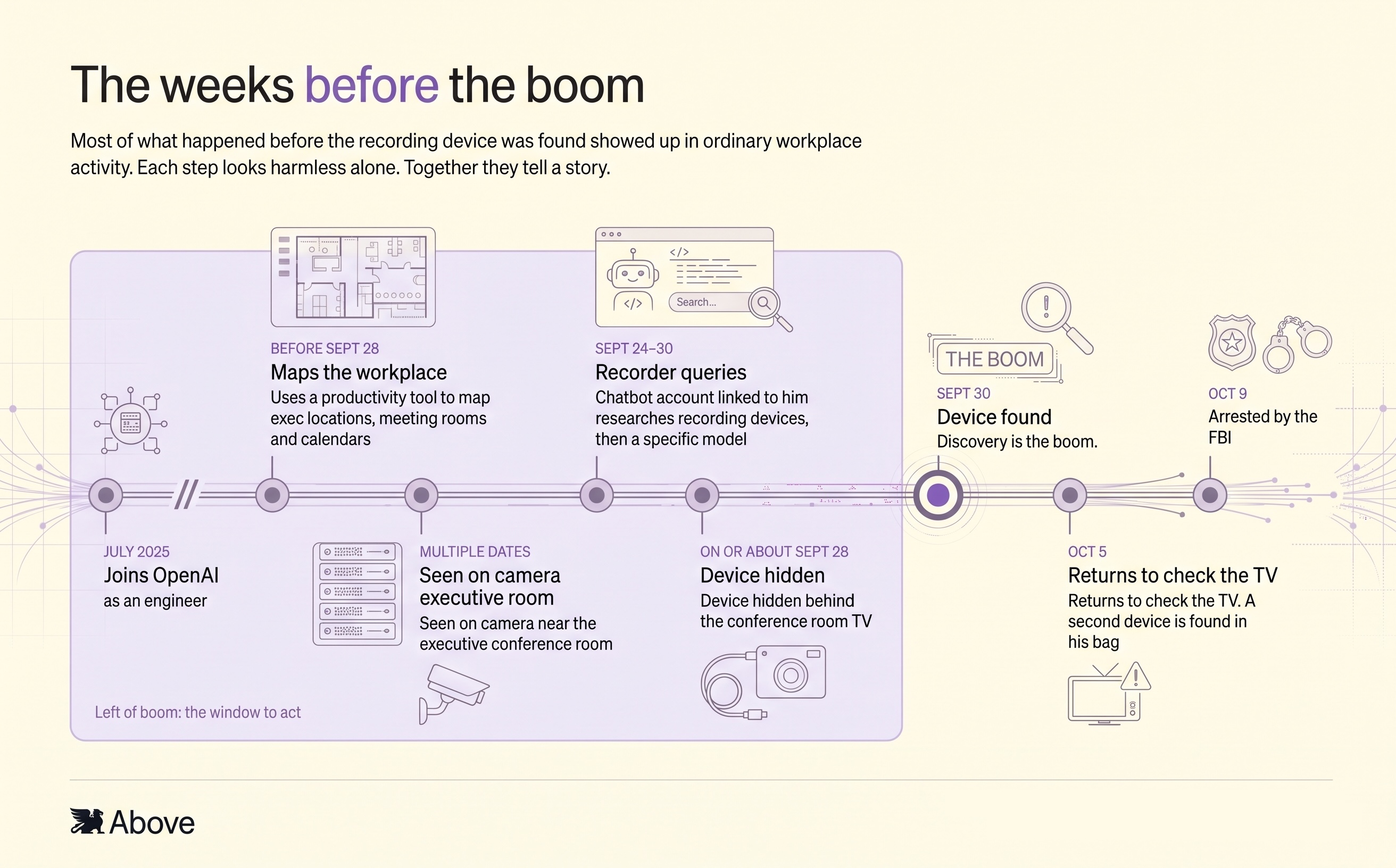
Lay that out and a familiar shape appears: reconnaissance, planning, acquisition, execution. Notice where finding the physical device sits on the timeline: the very end. The reconnaissance is what sits at the very beginning, and it was digital.
Insider risk, especially modern and sophisticated insider risk, is treacherous because it lives in very legitimate, everyday workflows. Every early signal on that list has an innocent explanation. Engineers book meeting rooms all day. Asking where leadership sits could mean someone wants a hallway conversation with the CTO. Walking past a conference room is not a policy violation.
That is exactly why traditional tooling stays quiet here. No data moved, so a DLP policy has nothing to fire on. No single event crosses a threshold, so a rules engine shrugs. An anomaly score might twitch, then get tuned away as noise because deviation on its own is not risk.
What changes the picture is the combination, read in context. An engineer with no role in executive meetings, mapping where executives sit and when they meet, then lingering near the room where those meetings happen. The useful question is not "is this event unusual?" It is "why is this person doing this, right now?" and “What else have they done that could be a contributing factor?”
That is what moves from anomaly detection to actual risk management. Deviation doesn’t inherently mean risk, but multiple deviations can certainly mean risk.
Our customers often ask us for practical advice on how to manage these threats “left of the boom.” Outside of implementing Above, here are some tactical pointers to consider moving forward:
Treat reconnaissance as a signal. Most programs are built to catch the exfiltration event. The higher-value window is earlier, when someone is learning the environment and planning. Above's AI investigators look for early indicators at the reconnaissance and planning stages, before any data moves, and reason over the sequence of behavior to understand intent.
Bring the human context in. "Searched for executive calendars" means nothing without "who is this person, what is their role, and has anything changed?" Above enriches technical activity with organizational and identity context such as role, department, manager and tenure, so the investigator can tell a chief of staff from someone with no business being there.
Connect the threads into one story. In this case the threads ran across a productivity tool, a chatbot account and camera footage. Above builds every case around a time-ordered timeline with the investigator's reasoning attached, so a security lead sees a narrative, not a pile of alerts.
Escalate attention, not accusations. Early signals justify a closer look, not a conclusion. Teams can place an identity on a watch list so investigators prioritize that person's activity, with Security, HR and Legal each seeing what their role allows.
Be honest about the edges. Some of the signals in this case would not, and should not, show up in any workplace monitoring tool. A chatbot account belonging to a spouse sits outside the employer's world. Above is a digital-telemetry platform, so badge readers and camera footage are not part of what we see. Strong programs pair behavioral investigation with physical security and HR, and they draw clear lines around what is in scope.
Most insider risk tools were built to wait. They wait for a file to move, a policy to break or a threshold to trip, then they hand a security team an alert and a reconstruction job. That works fine when the risk shows up as a single loud event. It works poorly when the risk looks like this case: weeks of quiet, ordinary-looking activity that only means something once someone connects it.
Above takes the other approach. Instead of writing better rules, we put AI investigators to work on the behavior itself. They watch how people actually work across identities, SaaS, data and endpoints, and ask the questions a seasoned investigator would ask: who is this person, what is normal for them, what changed, and why now? When the answer warrants attention, the security team gets a finished investigation with a timeline and the reasoning behind it, not another alert to triage.
Insider risk is an investigation problem, not a policy problem. It’s also a timing problem. The earlier you can read the pattern, the more options you have, and the more likely the outcome is a conversation instead of an arrest.
Insider threats come in every color, from espionage to simple negligence. Our job is to help you see them when the risk starts developing, not when you find the recording device.


May we use analytics cookies to understand visits, clicks and demo requests? Your choice won’t affect the site. No session recordings. Privacy policy